Updated on 24 March 2026
Original article published on 27 June 2018
We’ve created a short itinerary with suggestions so that you can better enjoy the Viewpoints of Penha de França and of Monte Agudo.
In Lisbon there are many viewpoints due to its natural uneven terrain that resulted in the well-known designation of City of Seven Hills.
The national and foreign tourists should not miss the most emblematic viewpoints, such as the one of Portas do Sol, which has a view over Alfama, the two of Graça and of São Pedro de Alcântara.
There are, however, others equally worth a visit, such as the viewpoints of Penha de França and Monte Agudo, which lie just 1 km apart. Today, these magnificent vantage points are already part of the route for those seeking to admire Lisbon from its hills.
We’re going to visit the Church of Nossa Senhora da Penha de França, observe an old water tank and appreciate a tile panel made by Querubim Lapa.
We start our route in Travessa do Calado in front of the Parish Council of Penha de França.
getLISBON Private Tours
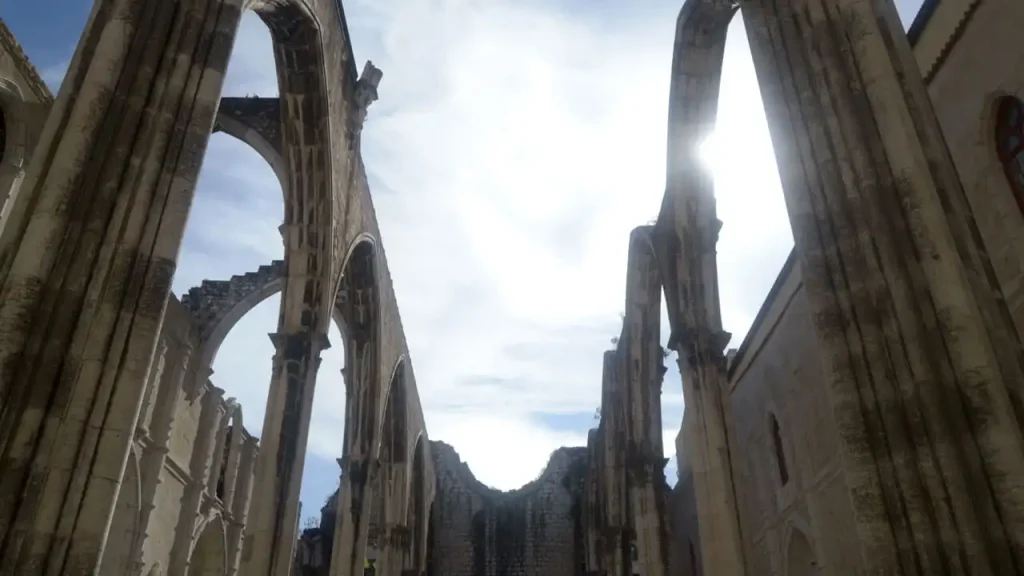
Private Tour “Lisbon and the 1755 Earthquake”
Led by sociologist Guilherme Pereira, we set out to discover the reinvented city and the traces of the earthquake that still remain. Join us!
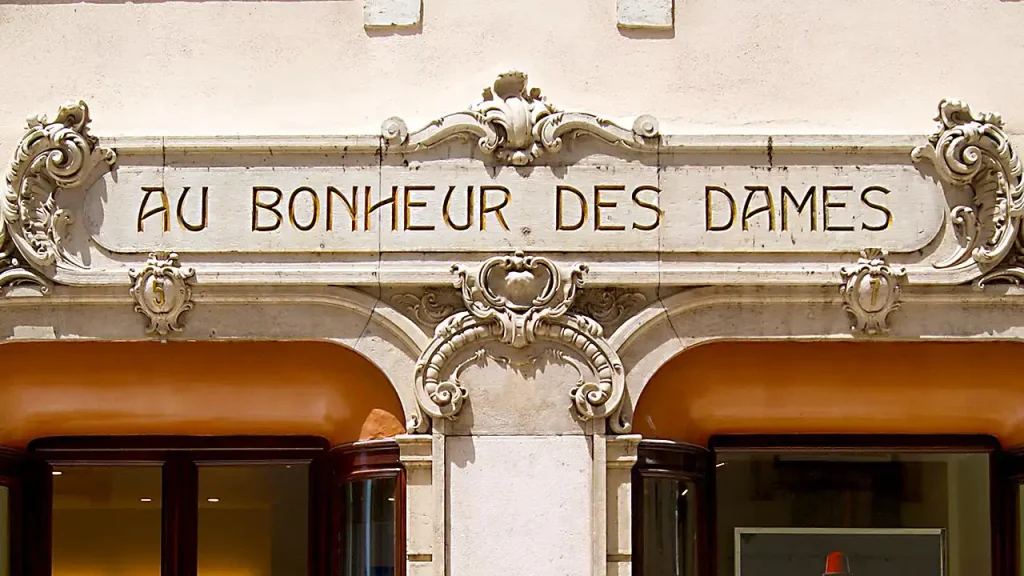
Private Tour “Lisbon Through Its Traditional Shops”
Through Lisbon’s Traditional Shops, the sociologist Guilherme Pereira will explore with you the city from the nineteenth century to the present day. Unmissable!
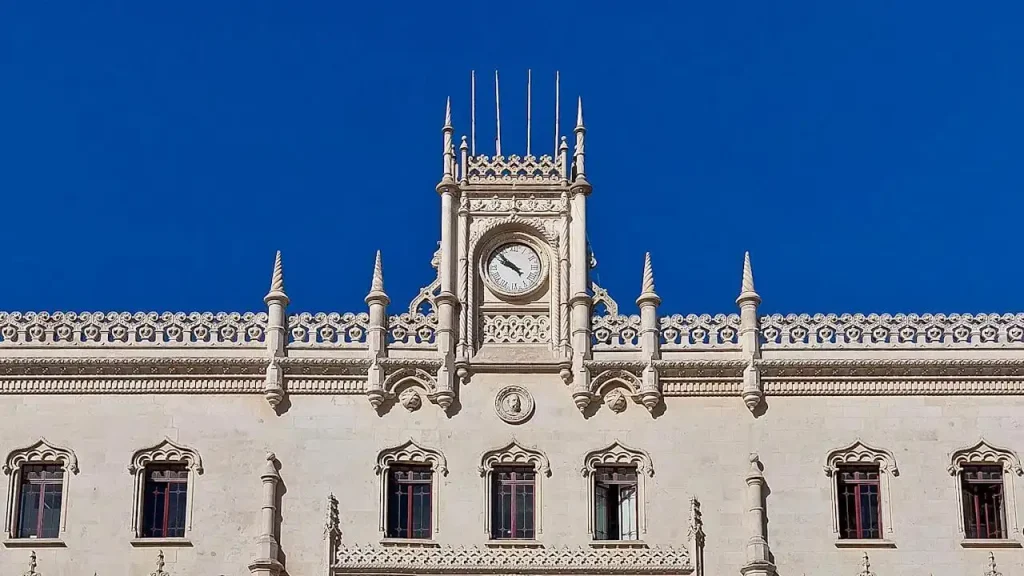
Private Tour “The Railway Stations of Lisbon”
We’re going to explore the history of the railway, its infrastructure and architecture, as well as many other aspects and curiosities. Led by art historian António Simões.
Tilework Panel in the Parish Council Building
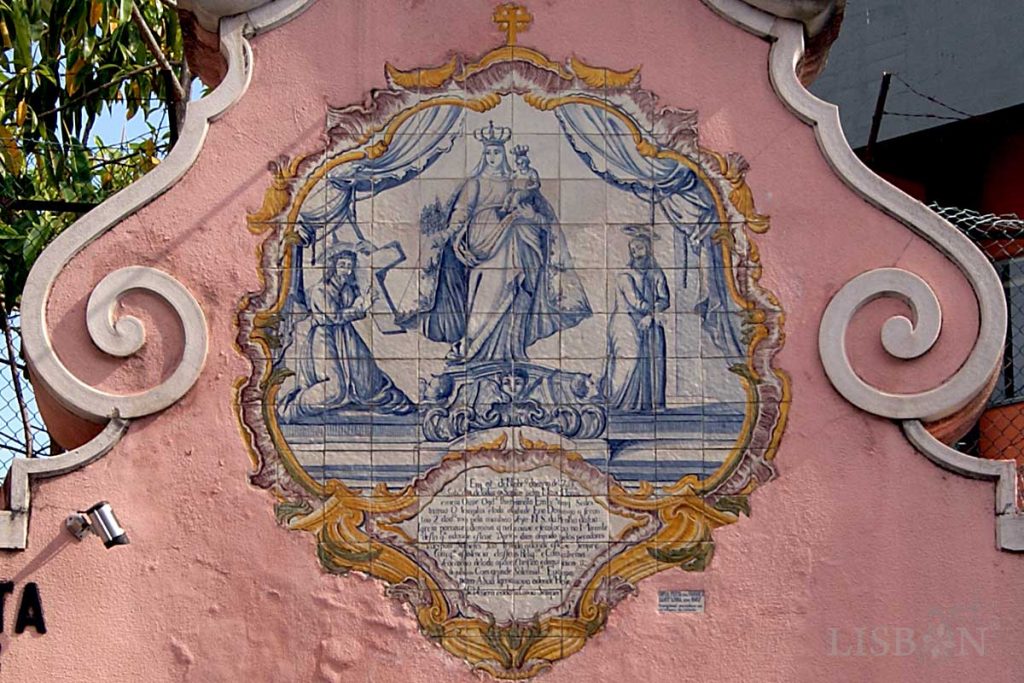
It was in this small palace that, during the rebuilding of the Church of Penha de França, the original image of Our Lady that resisted the earthquake of 1755 was kept. This fact was documented in a magnificent polychromatic tilework panel, with an inscription, that we can observe above the door.
This is a reproduction produced by the Santana Factory in 1987 that replaces the original that is protected in the Museum of Lisbon, but that is still worth seeing.
The Origin and Legend of Penha de França
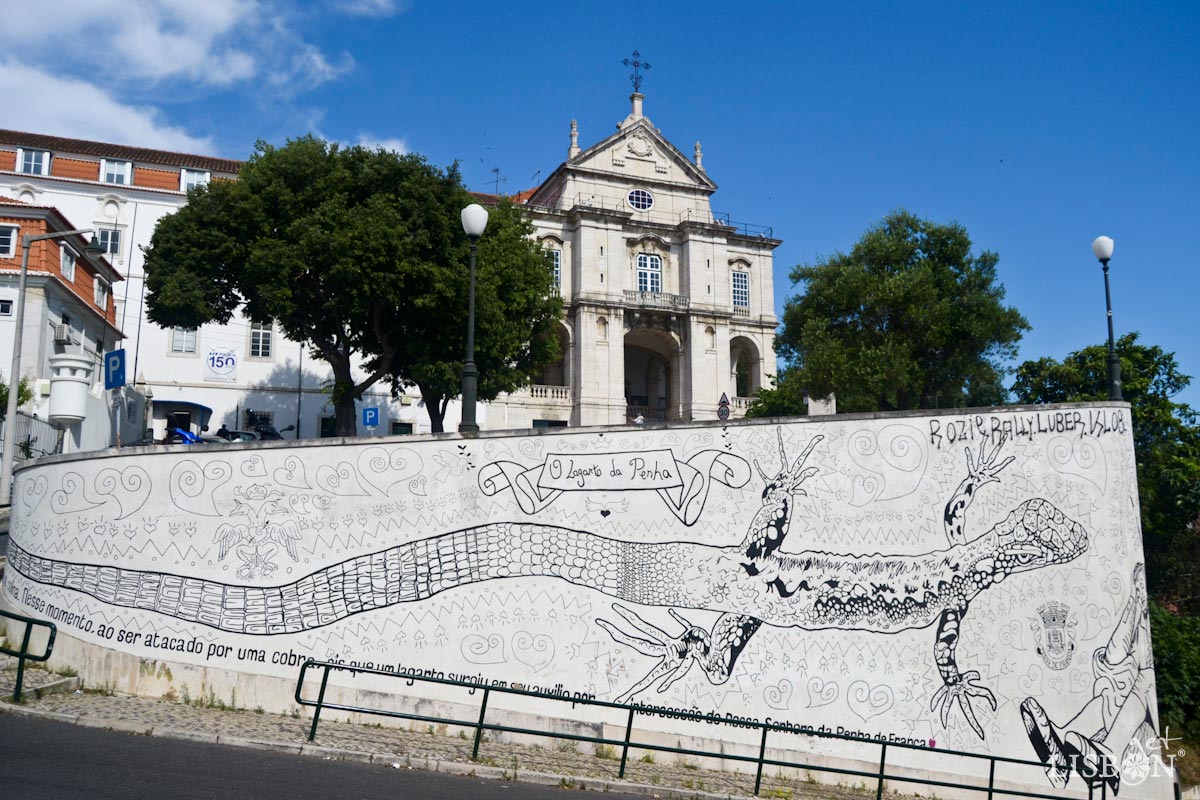
When entering the Penha de França Square, we find ourselves in the place where in 1597 a small church was built.
António Simões, a sculptor of images imprisoned in Alcácer Quibir, promised to the Virgin the execution of images praising her if he was saved from captivity. The miracle was conceded, and the promise was kept! One of the images he reproduced was dedicated to Senhora da Penha de França, a cult with origin in Salamanca, which found a home in this church.
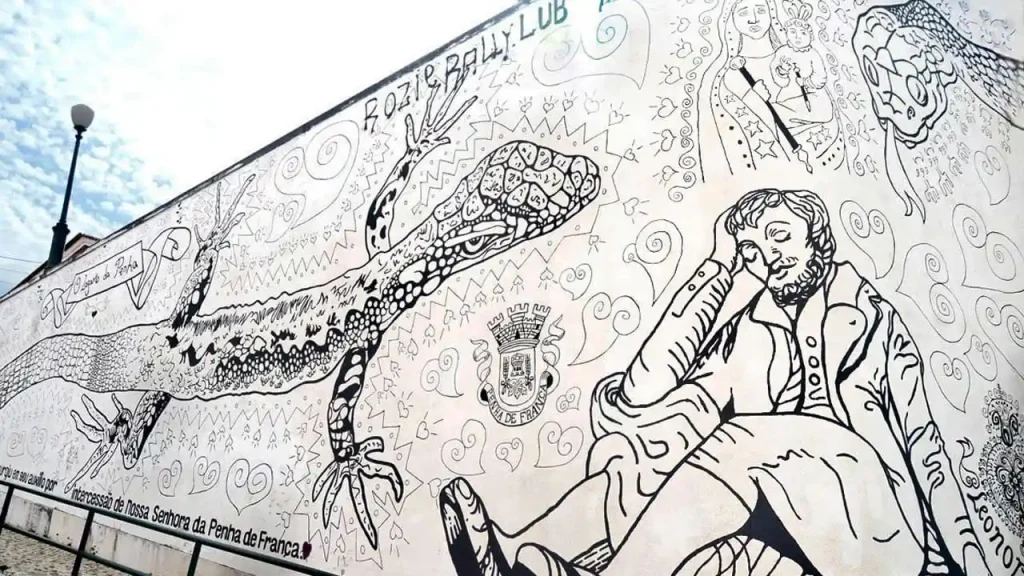
Before reaching the church, we come across a large mural by Leonor Brilha, who also created one of the works featured in Women in the Urban Art of Graça Neighbourhood. The theme of the mural refers to the curious legend associated with Our Lady of Penha de França, which we will now share.
One day a sleeping pilgrim on the mountainside was awakened by a huge lizard before being attacked by a snake who, surprised, turned away. A devotee of Our Lady of Penha, the man considered that it would be a miracle and thus, the tradition of the Lizard of Penha appeared.
This episode is also present in a large polychromatic tile panel that exists on the outside of the apse of the church. Its location doesn’t allow a great observation of this panel, but it is still worth a look.
Also in a room adjoining the church, a lizard and a snake carved in wood remind us of the legend.

😊 Have you discovered our LISBOA MARCA book of bookmarks yet?
It is a journey through Lisbon told across 18 detachable bookmarks featuring beautiful illustrations by five urban sketchers. It is undoubtedly an excellent gift for anyone who loves the city of Lisbon. 🎁
Get yours! 👇
The Church of Our Lady of Penha de França
In the 17th century, a new construction, a church and a convent, took the place of the small church.
Today, we can see the result of the rebuilding concluded in 1785 after the dreadful earthquake that damaged the buildings, and of some restoration initiatives of the 20th century.
Let us then visit this amazing building.
The façade of the church is divided into three parts separated by two buttresses, in a mix of Mannerism and Baroque. However, it’s the interior that surprises us. We can access it via a monumental staircase, but we note that for people with reduced mobility, the access is made via a side entrance.
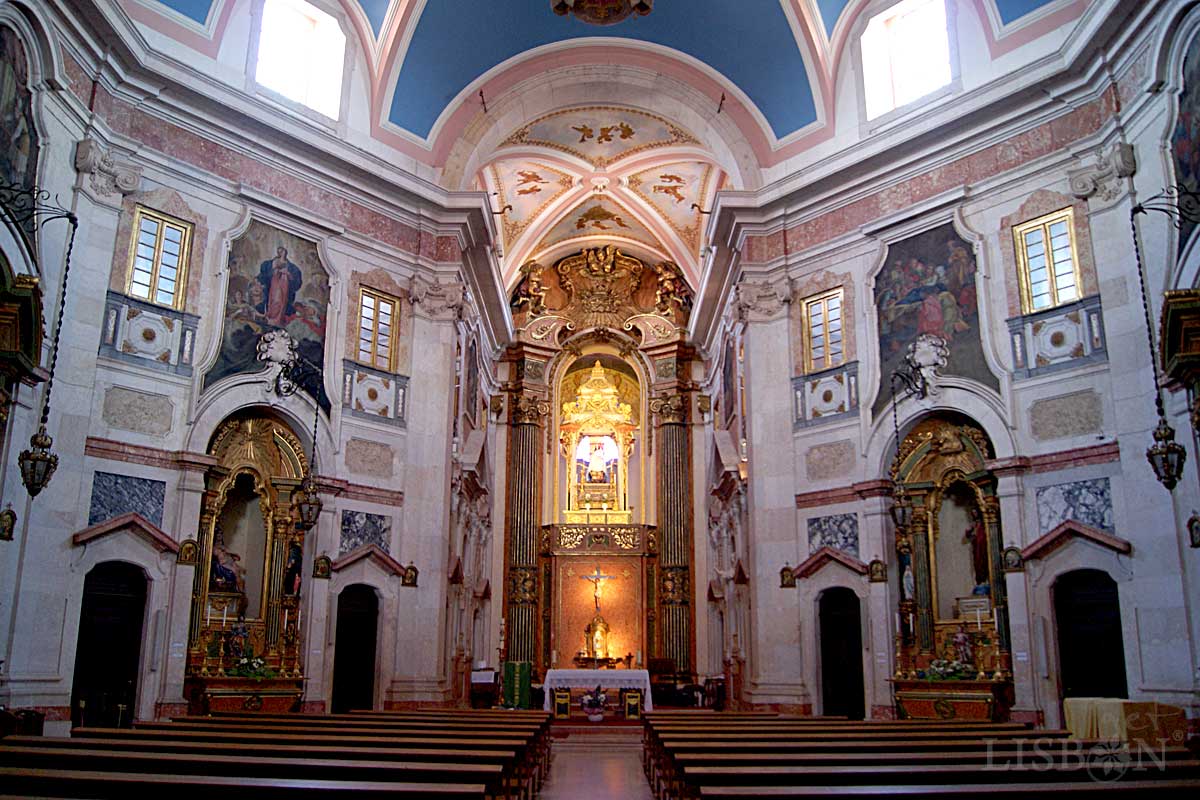
We’re then faced with a church with an octagonal plan, in which its main chapel is where the original image of Our Lady of Penha de França made by António Simões is.
All of its interior is monumental! The walls in coloured limestone alternate with wooden altars painted to fake stones.
We highlight the paintings made by Vieira Portuense (1765-1805) and two big statues of São Pedro and São Paulo in niches of the main chapel created by Machado de Castro (1731-1822).
The church also has spaces with tiles of the 17th and 18th centuries that remind us that this was a house of the Order of Saint Augustine.
The whole set of buildings and mobile assets was in November 2017 classified as a Monument of Public Interest.
After knowing a bit about the Church of Penha de França and before proceeding to the viewpoint, we observe the water tank that stands out in the landscape.
You may also like

Private Tour “Jewish Lisbon”
Here we’ll explore the Jewish presence in Lisbon from the medieval period to the present day. Don’t miss this private walking tour led by historian Marisa Filipe!
Private Tour “Lisbon of Spies”
Uncover highly secret stories on this tour, exploring unexpected places where conspiracies once unfolded — led by historian and espionage expert Marisa Filipe.

Private Tour “Touring Around Rossio”
On this tour, you will travel through time as you explore key episodes in the history of this city. Discover the essence of Lisbon with the sociologist Guilherme Pereira!
Water Tank of Penha de França
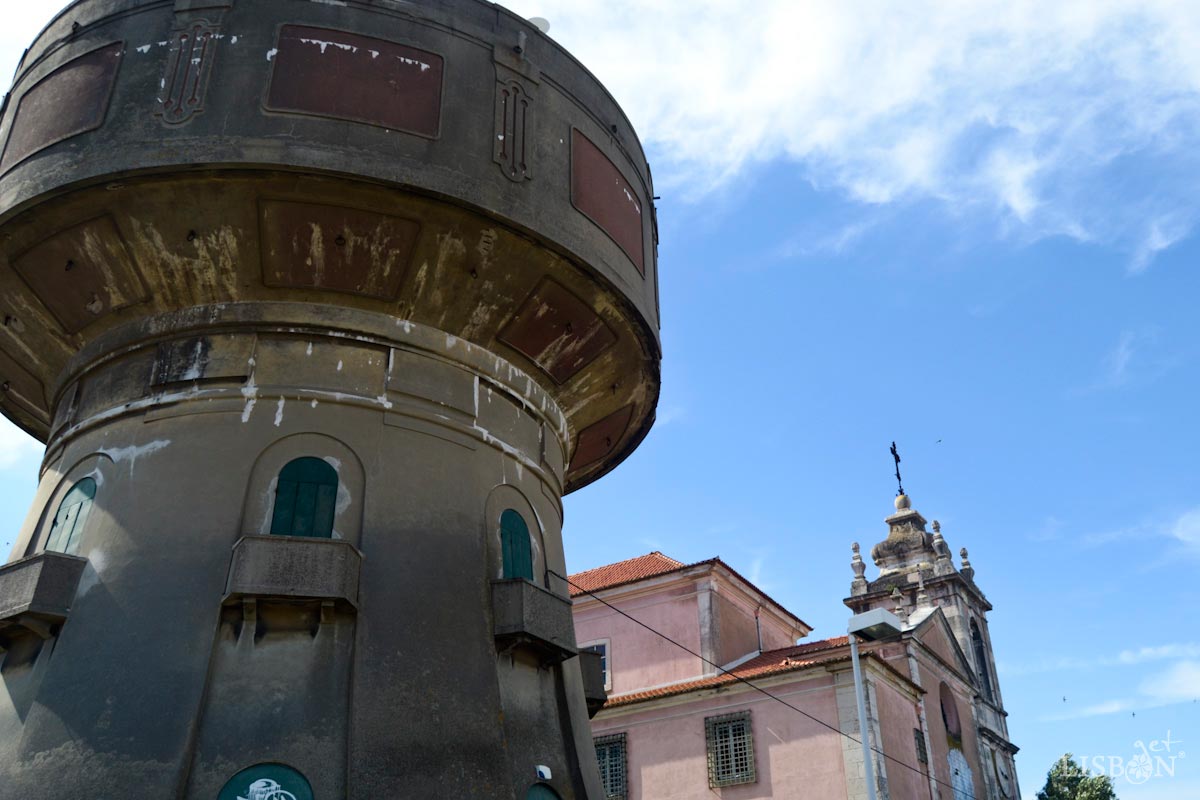
In the rear zone of the church is the deactivated high tank of Penha de França, built between 1929 and 1932. This water deposit was part of the hydraulic infrastructure that used the cistern of the convent of Penha de França to supply water to the high points of the neighbourhood.
Let’s now discover the Viewpoints of Penha de França and of Monte Agudo.
Viewpoint of Penha de França
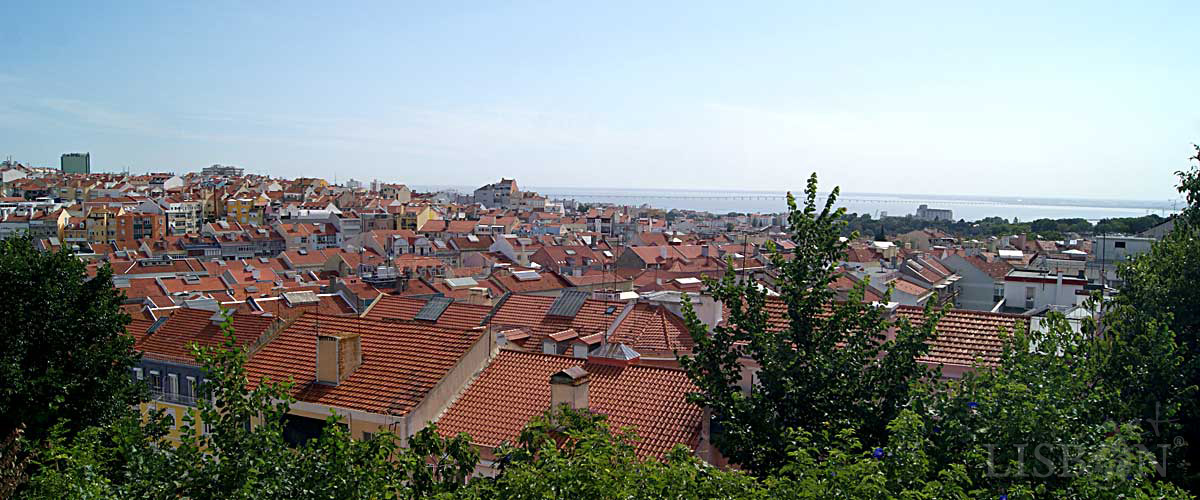
By going around the church and going though Rua Marques da Silva, we arrive to the viewpoint. Here we have an incredibly wide panorama. We can see from the eastern zone of Lisbon, with the Vasco da Gama Bridge in the background to the western zone, with the Monsanto Forest Park and the Amoreiras as part of the landscape. In days of clear sky it is possible to observe the Palmela Mountains and the Sintra Mountains, in opposite directions.

After being dazzled, we go back to Penha de França Square towards Rua Penha de França. We walk 5 minutes and arrive to the Secondary School Dona Luísa de Gusmão.
Tile Panel by Querubim Lapa
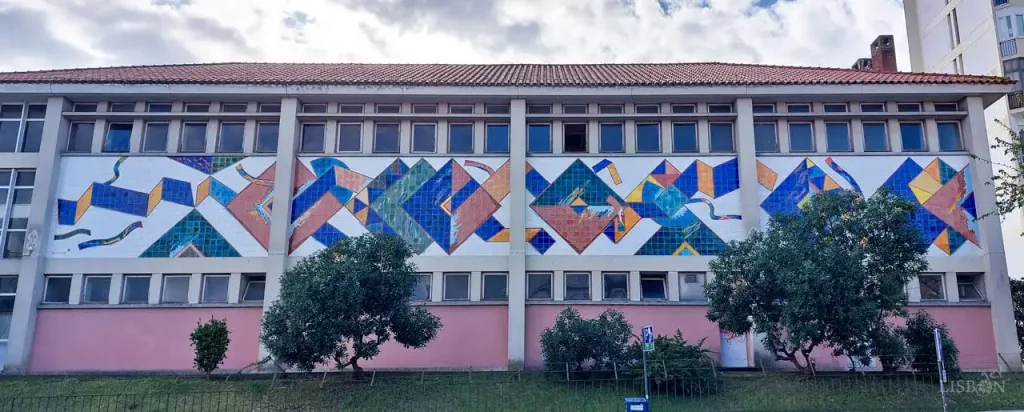
We make a brief stop to observe the tiled panel by Querubim Lapa (1925–2016), widely recognised as one of the most important Portuguese ceramic artists, noted for his innovative artistic and technical solutions.
Among the many ceramic works by this artist scattered across the city of Lisbon, this one from 2005, measuring around 30 metres in length, has fortunately now been restored.
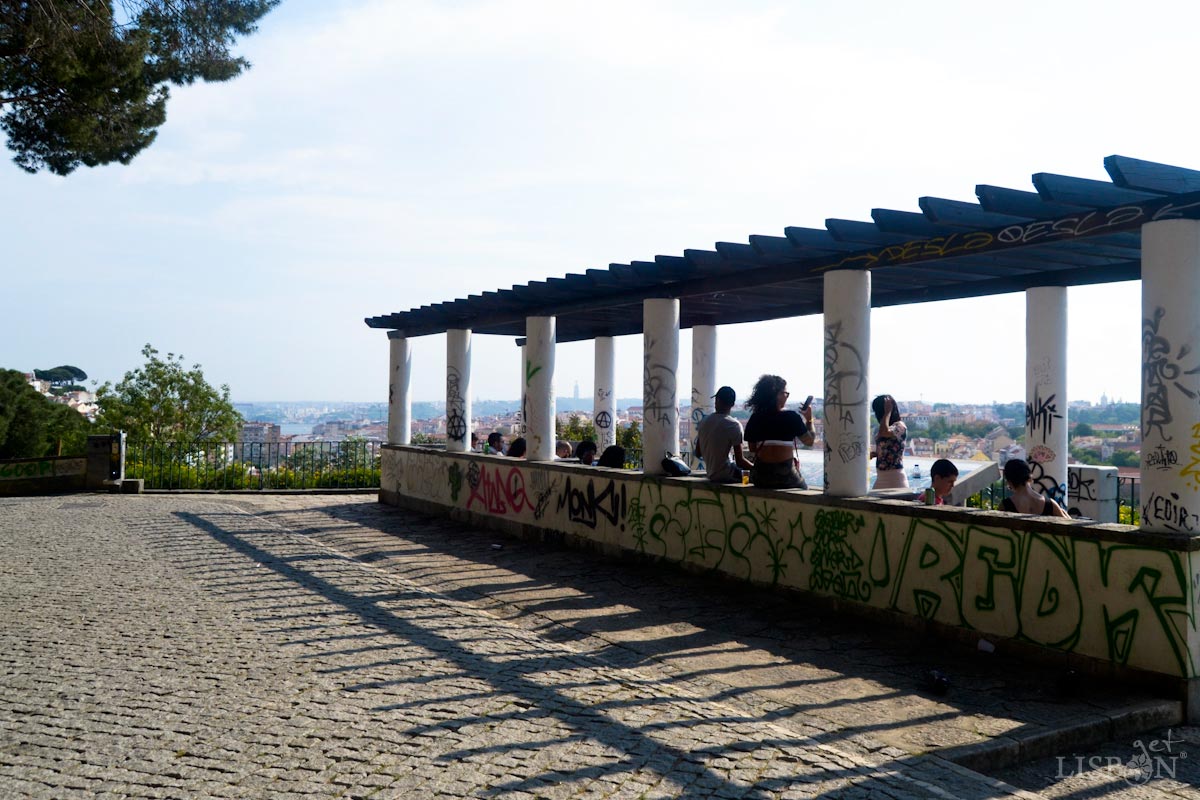
After the school, we arrive to the beginning of Rua Heliodoro Salgado. Here is the entrance of the Viewpoint of Monte Agudo.
| Never miss another article | Subscribe here |
Viewpoint of Monte Agudo

An extraordinary vantage point, from which one can enjoy a panoramic view that stretches from the famous Senhora do Monte viewpoint to the southern bank of the Tagus, passing over the Colina de Santana and the entire northern area of the Avenidas Novas.
This place, equipped with a kiosk serving drinks and light meals, invites a longer pause to take in its magnificent view.
Also read Tiled Panoramas of Lisbon by Fred Kradolfer where the tile panel of Monte Agudo is included.
At the end, the exit can be made by the pedestrian walkway, through stairs, that has a connection to Rua Ilha do Príncipe. From here to Avenida Almirante Reis is only a short distance.
We hope you enjoyed it and that you accept the invitation to take a stroll through this small but rich itinerary to get to know the Viewpoints of Penha de França and of Monte Agudo. 🙂
The project getLISBON has been very rewarding and we want to continue revealing the singularities of fascinating Lisbon.
Help us keep this project alive!
By using these links to make your reservations you’ll be supporting us. With no extra costs!
• getLISBON offers a selection of carefully curated cultural private walking tours in Lisbon that go beyond the usual themes.
• Looking for a different experience? We can create a customised itinerary based on your interests. Contact us!
• Or if you prefer tours and other activities in various destinations, take a look at GetYourGuide.
• Save time and money with a flexible Lisbon Card!