Beyond being an artistic expression, urban art has proved to be an important means of raising awareness of the many issues present in society, particularly among younger generations. In this month in which we celebrate the Revolution, we bring you 25 April in the Urban Art of Lisbon.
In our article 25th of April 1974 Landmarks in Lisbon, we explain why it is important to mark this historic day, yet it is never too much to highlight the first Freedom Day, which granted the Portuguese access to education, healthcare, free thought, non-discrimination and so many other aspects that have allowed us to evolve as a society and as a people.
However, it is important to stress that a democracy once achieved is not the same as a democracy guaranteed. Constant reflection and vigilance are required…
With this in mind, we have gathered several works on 25 April in the Urban Art of Lisbon which, in addition to paying tribute to key and emblematic figures of the Revolution, invite us to reflect on fundamental concepts that we must never, under any circumstances, relinquish.
25 April Celebrated in the Urban Art of Lisbon
Let us explore several neighbourhoods across the city in search of murals created to mark the 50th anniversary of the 25 April 1974 Revolution.
5 decades | 5 artists | 5 murals – Where is Freedom?
This initiative was launched by GAU – Urban Art Gallery, which invited five urban artists, whose careers represent the five decades of the history of urban art in Portugal, to create five projects in different locations across Lisbon.
Each of the invited artists — António Alves, Youthone, +MaisMenos-, Kruella D’Enfer and Arisca — approached the theme of 25 April from their own perspective, under the motto “Where is Freedom?”.
António Alves
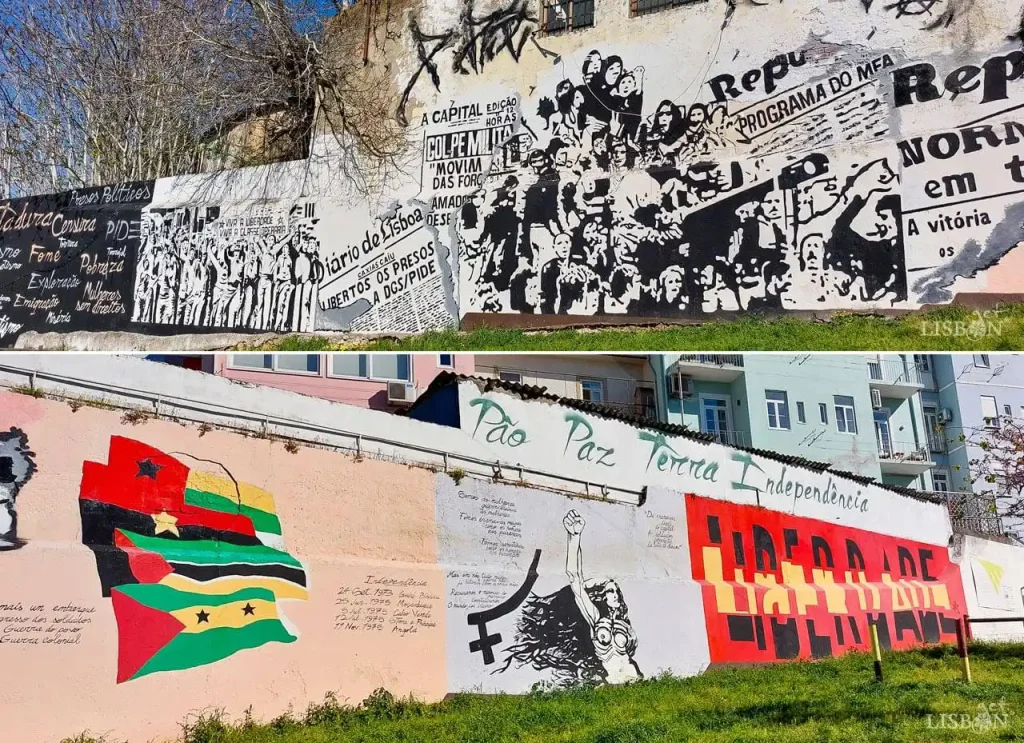
António Alves is a muralist who stood out for his interventions of resistance and counterpower in the 1970s and 1980s.
In this work, approximately 60 metres long, located at the junction of Calçada dos Mestres and Avenida Calouste Gulbenkian, we can observe different sections portraying representative moments of the Revolution.
It begins with an evocation of the dictatorial regime, represented by words such as hunger, PIDE or censorship, written against a black background. This is followed, in black and white, by the uprising of the working class and a human crowd celebrating the Revolution atop a tank. Newspaper clippings with headlines of the first major events following the fall of the regime frame the scene.
The mural then transitions into a colourful section referring to the independence of the former colonies and the end of the colonial war. Before the final section, the role of women and class struggle are highlighted in shades of black, white and grey. The work concludes with the word FREEDOM against a red background, which António Alves believes is nowadays much mistreated.
By purchasing your tickets here you are supporting the getLISBON project.
Youthone
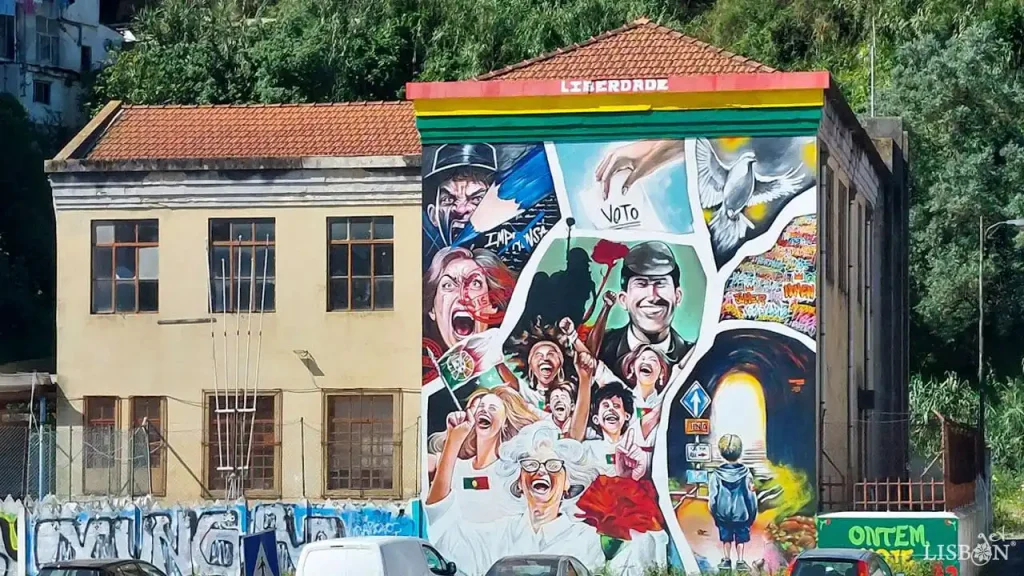
On Rua B in Bairro da Liberdade, Adalberto Brito, aka Youthone — one of the pioneers of graffiti in the 1990s — presents a composition made up of fragments of the history that shaped the Revolution.
It recalls the regime that imprisoned the country through repression, control and prohibition. It also evokes moments of joy and freedom achieved by the Armed Forces Movement — the right to demonstrate, the power of voting and peace. However, the future presents uncertainties that require a path to be pursued with courage, symbolised by a child facing a dark tunnel, heading towards a light-filled horizon.
The Revolution is an ongoing process that extends through time, and there is still a long way to go.
+MaisMenos-
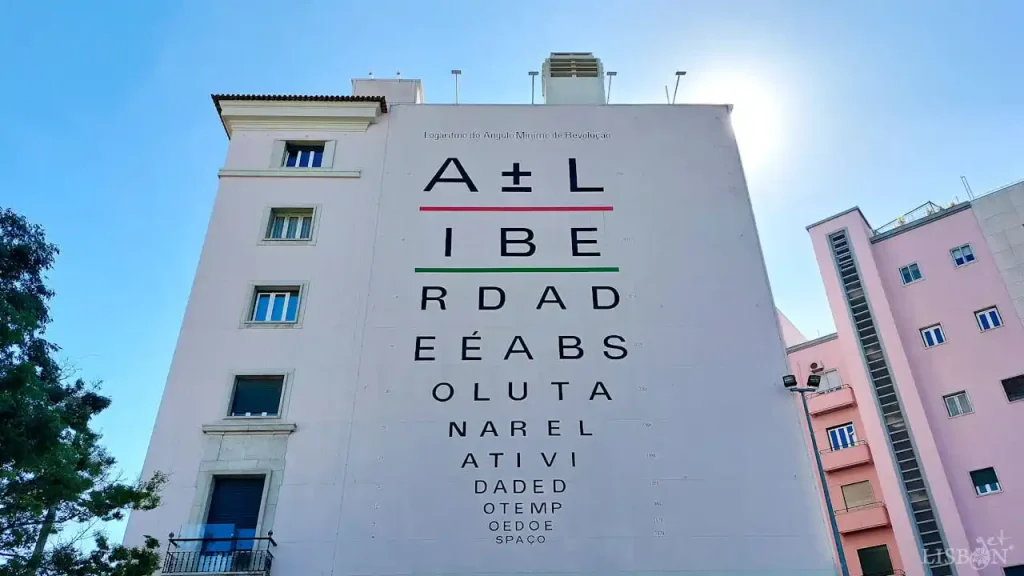
On Avenida Almirante Gago Coutinho, near Praça Francisco Sá Carneiro, in the EMEL car park, we find the mural by Miguel Januário (+MaisMenos-). Representing the 2000s in this GAU initiative, the artist also took part in “Às 5, no Mercado” — The Urban Art of Chão do Loureiro Car Park.
In this case, his approach challenges the public through a visual acuity test inspired by Einstein’s Theory of Relativity. The artist replaces the component of the speed of light with freedom, making it the constant element in the relativity of time and space. “Therefore, the further we move away from the Revolution and from 25 April, the more we lose the true essence of what the Revolution was, and it is important to keep testing our perspective…”
“We live in an inverted time… countries are bombed in the name of democracy, so to what extent is freedom, or the idea of freedom, the one we were promised? It is probably unfulfilled, which is why we must look at it critically.”
Kruella D’Enfer
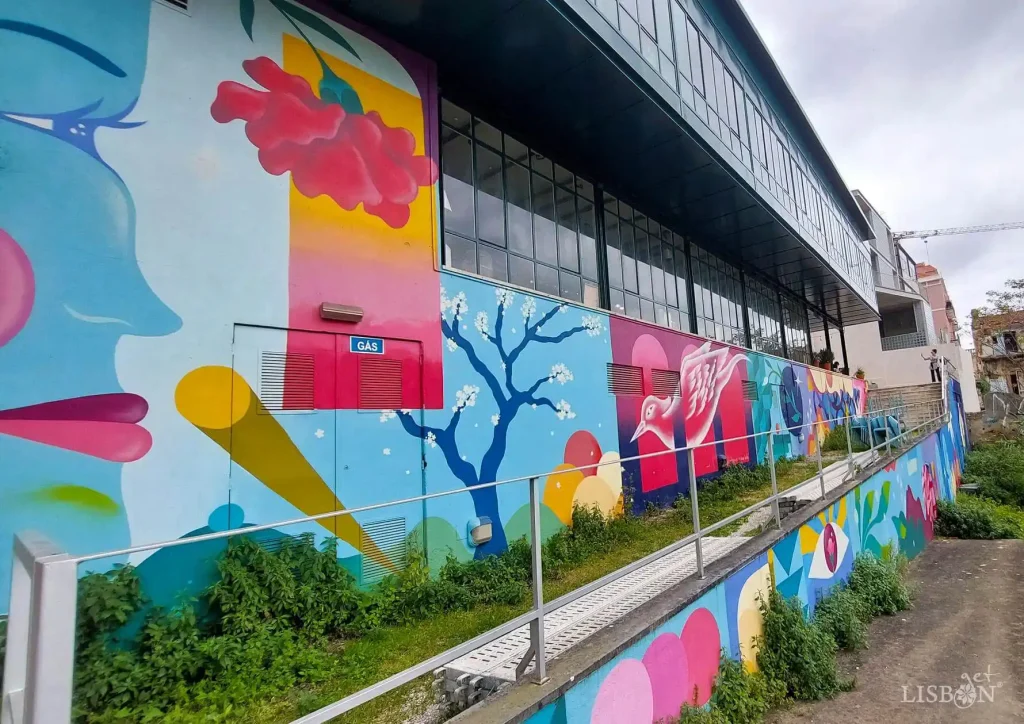
To access the mural by Kruella D’Enfer, a visual artist who stood out in the 2010s in urban art, we invite you to visit Café da Garagem, at Teatro Taborda, in Costa do Castelo, from where a privileged view over the northern side of old Lisbon can be enjoyed.
The composition is located at the rear of the building, spread across two wall levels and covering an area of around 180 m².
The artist’s approach — also featured in Urban Art of Marvila — consists of combining the concept of Freedom with the theme of theatre. Representation is a form of artistic expression, communication and entertainment, but also of social reflection and inspiration for generations.
Kruella D’Enfer builds this path through vibrant colours and geometric and vegetal elements, incorporating symbols such as the dove of peace, theatrical masks linked to the venue, and a carnation emerging from thought — as an evocation of the need not to forget the true essence of the Revolution.
Arisca
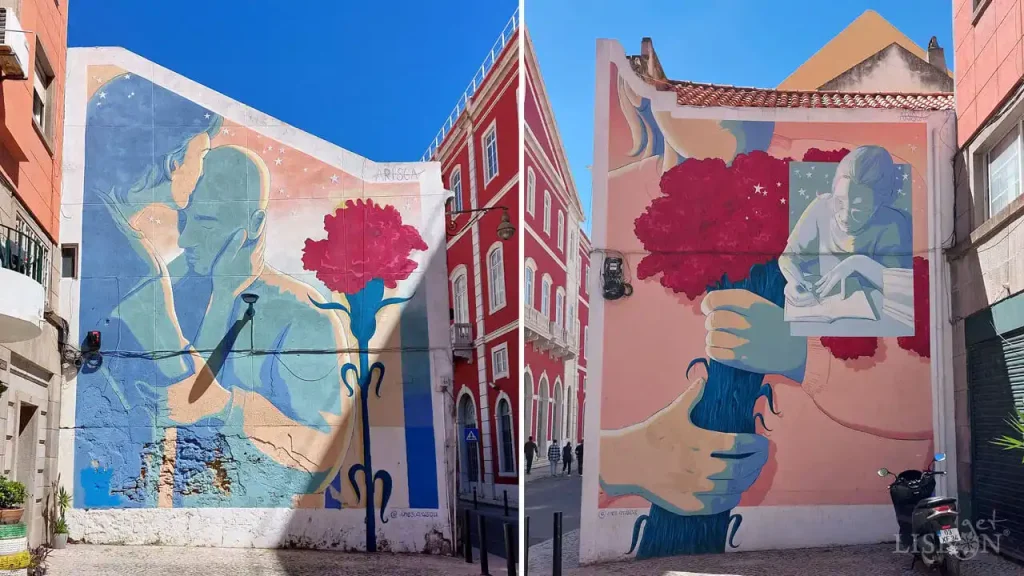
At numbers 66 and 58 of Rua dos Caminhos de Ferro, in Santa Apolónia, we find, on the gable walls of two buildings, the paintings entitled Equality (left) and Wisdom (right), created by Arisca, an artist representing the 2020s.
In both works, alongside the carnation — the symbol of the Revolution — there are figures that convey two important concepts, explained by the artist in her own words:
- Equality (left): “There is no freedom without equality… I believe the way to achieve it is through empathy and discernment, all seasoned with great care and determination.”
- Wisdom (right): “Freedom only happens through the pursuit of knowledge and information. Education and sharing are essential to our evolution.”
Celeste Caeiro
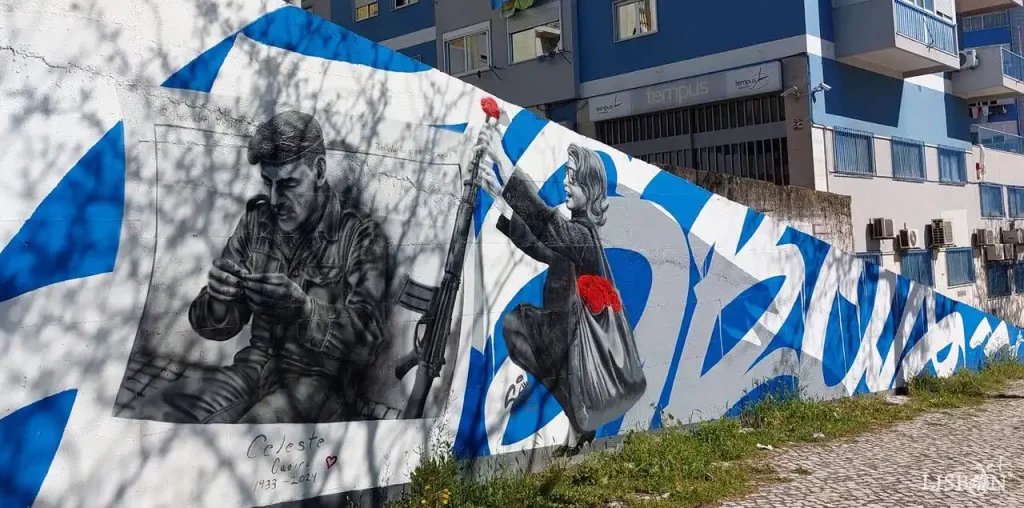
Canadian urban artist Paul Gly-Williams, aka SumArtist, created his first work in Europe in 2025, specifically in Lisbon, on Avenida Infante D. Henrique, paying tribute to one of the emblematic figures of the 25 April Revolution, Celeste Caeiro (1933–2024).
The gesture of offering flowers to armed soldiers represents, in the artist’s words, a “message of peace, courage and transformation”. He also believes that “beauty and empathy can still rewrite history”, which has so often been marked by “division and aggression”.
50 Years of SPGL
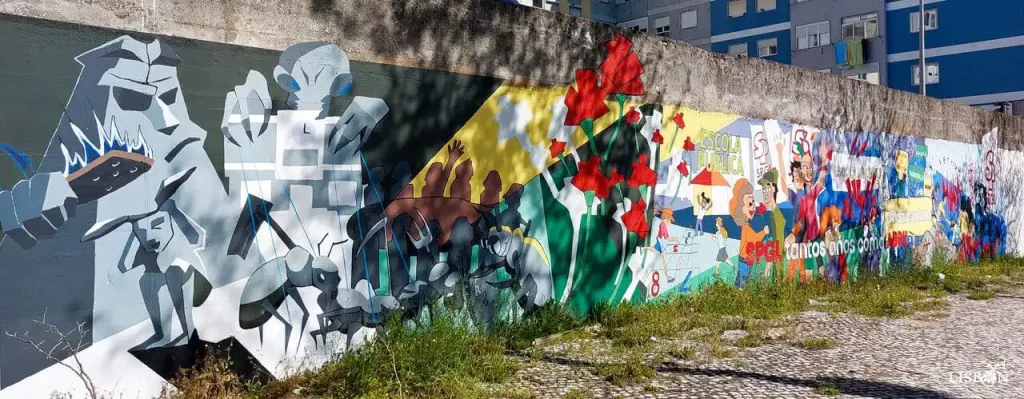
Along the same wall where SumArtist’s mural can be found, students and teachers from Escola António Arroio, together with members of the Sindicato dos Professores da Grande Lisboa (SPGL), created a collective mural to mark the 50th anniversary of this organisation.
It offers an evolving narrative, beginning with elements referring to the repression of the dictatorship. Red carnations — evoking 25 April — interrupt this grey period, followed by the achievements of the Revolution: access to education, greater recognition of the teaching profession… and living in freedom.
| Never miss another article | Subscribe here |
Salgueiro Maia
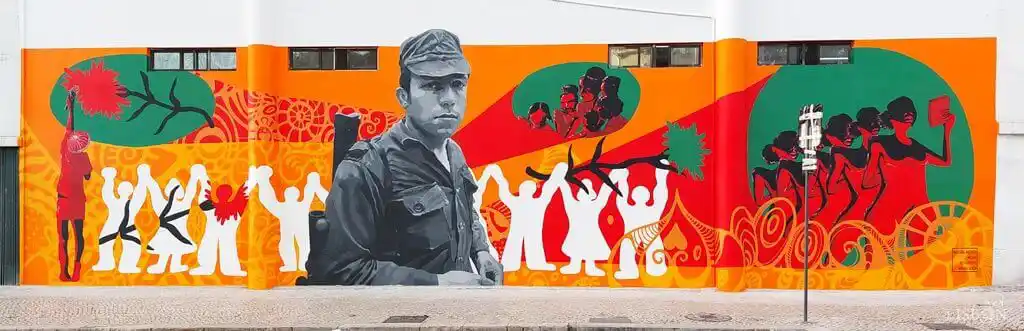
This article on 25 April in the Urban Art of Lisbon would not be complete without the tribute to Captain Salgueiro Maia (1944–1992), located on Avenida de Berna, on the outer wall of the NOVA University Lisbon School of Social Sciences and Humanities.
This work, described in more detail in Urban Art Tributes to Personalities in Lisbon, was created in 2023, replacing an earlier mural that portrayed the same figure but had already fallen into a state of significant deterioration.
The current mural was painted by four female artists — Tamara Alves, Sara Fonseca da Graça, MOAMI and Mariana Malhão — as part of the celebrations of the 50th anniversary of 25 April and the 45th anniversary of the Faculty.
In April, a Thousand Carnations
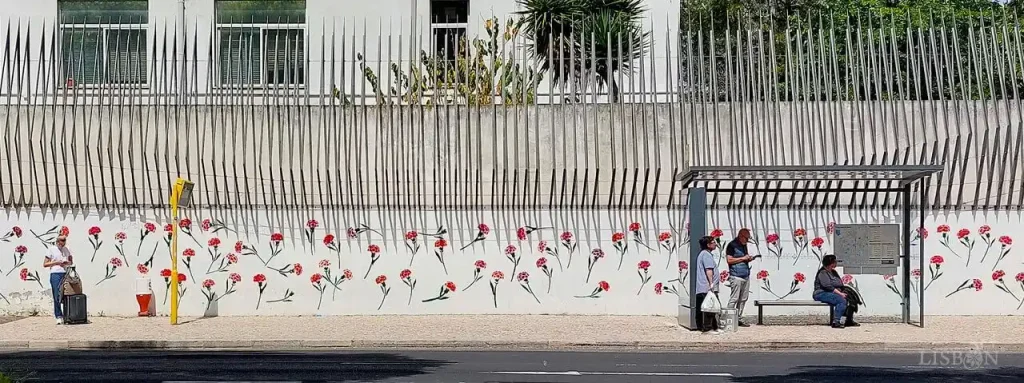
Continuing the celebrations of the 50th anniversary of the Revolution, in 2024 the NOVA School of Social Sciences and Humanities once again marked 25 April through urban art.
A series of activities was promoted, including stencil workshops that involved the entire community, collectively bringing April to the Faculty’s exterior wall through the painting of hundreds of red carnations.
These interventions on 25 April in the Urban Art of Lisbon stand as a living testimony of collective memory and a constant invitation to reflection. The murals remind us that the values achieved in April require an ongoing commitment, challenging each generation to preserve and reaffirm the true meaning of Freedom.
25 April, always!
The project getLISBON has been very rewarding and we want to continue revealing the singularities of fascinating Lisbon.
Help us keep this project alive!
By using these links to make your reservations you’ll be supporting us. With no extra costs!
• getLISBON offers a selection of carefully curated cultural private walking tours in Lisbon that go beyond the usual themes.
• Looking for a different experience? We can create a customised itinerary based on your interests. Contact us!
• Or if you prefer tours and other activities in various destinations, take a look at GetYourGuide.
• Save time and money with a flexible Lisbon Card!